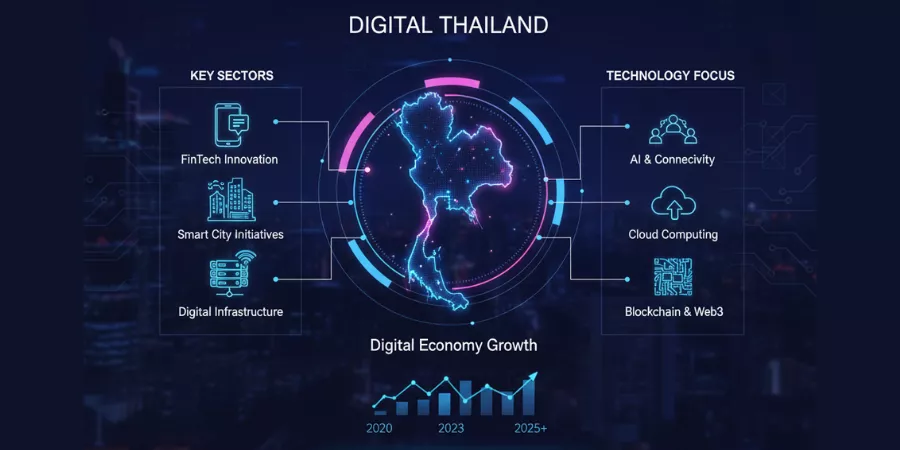
Thailand has rapidly moved into a new phase of digital technology in Thailand adoption. According to recent data, about 65.4 million individuals in Thailand were internet users as of January 2025, that equates to about 91.2% of the population. In addition, Thailand digital economy is estimated to contribute roughly six percent of national GDP in 2023, with expectations to reach around 11% by 2027.
This blog will walk through how digital technology in Thailand is taking root across sectors in Thailand, what it means in practice, and where the gaps remain.
Digital Connectivity and Infrastructure in Thailand
A strong base of connectivity supports much of the change. Thailand counted 99.5 million cellular mobile connections in early 2025, representing about 139% of the population (people often hold more than one connection). Household internet access has also climbed: by 2024 around 21.7 million Thai households were connected to the internet, up from 21 million the previous year.
The government and private sector have invested in broadband, data centres, and cloud services Thailand. For example, Thailand’s ICT market size was estimated at USD 17.74 billion in 2025 and projected to reach USD 30.11 billion by 2030, growing at a compound annual rate of about 11.16%. What this really means is that the physical foundation for digital technology in Thailand is being strengthened along with Thailand digital infrastructure and connectivity.
Key Technologies Driving Change
5G and Broadband
Thailand is moving forward with 5G in Thailand deployment and better broadband in urban and rural areas through the use of technology. A research in Phetchaburi Province found that areas with 5G covered both the inner city and outer city, showing that there were differences in download speeds between zones that could be measured. This is important as the high-speed networks allow data-hungry apps, like video streaming or industrial automation, to be more effective in scaling up.
Cloud, Data Centres and Artificial Intelligence
Cloud services Thailand and data‑centre investment are major parts of the technology push. Thailand’s value of the digital technology in Thailand industry was over 2 trillion baht (in recent data) and software and digital services showed strong growth. The growth of cloud, data analytics and AI adoption Thailand offer companies and government agencies ways to process data, automate operations and deliver more sophisticated services.
The Digital Economy Promotion Agency (DEPA) highlights that investments in these areas are “crucial” for organisations seeking to remain competitive. For example, when firms move from storing files locally to using cloud platforms, they can scale faster, tap into new insights from data, and reduce some infrastructure costs.
Smart Agriculture and Internet‑of‑Things (IoT)
Digital technology in Thailand is reaching sectors beyond typical consumer tech. One research project developed a chatbot via the LINE platform to support farmers with irrigation monitoring, crop cultivation advice and remote control of systems.
In such an example, IoT applications Thailand sensors, chat interface and data flows combine to help an agricultural business operate more efficiently. These are the types of real‑world applications that show technology isn’t just novelty but can affect livelihoods. Initiatives like smart agriculture Thailand demonstrate how innovation spreads across sectors.
Economic and Social Impacts of Digital Technology in Thailand
Thailand is witnessing a gradual increase in the economic worth of digital technology in Thailand. In 2024, Thailand digital economy was valued at 4.44 trillion baht, which accounts for about 23.9% of the country’s GDP. The aforementioned growth of the digital services sector, software, and hardware industries is the main factor behind the impact of digital technology on Thai economy.
For example, in 2022 the software industry in Thailand expanded 19% to about 190 billion baht. On the social side, internet penetration Thailand among older age ranges and low‑income households is improving: the ratio of internet usage by people aged 55‑74 rose from 63.1% in 2022 to 71.6% in 2023. What this really means is more people are able to use digital services, access information, transact online and participate in new Thailand technology adoption across sectors.
Challenges and Gaps in Thailand’s Digital Transformation
- The digital divide is present across various demographics: People’s usage of digital devices and involvement in e-commerce are greatly influenced by age, gender, and level of education. Some segments of the population have either limited access to or lack of skills in using digital technology in Thailand, hence getting them marginalized in the Thailand digital economy.
- Small businesses have been slow to take up the digital economy: The percentage of jobs in the digital business sector rose to 36% in 2023, but still, most of the digital technology in Thailanduse is done by large and medium-sized companies. The smallest companies are finding it difficult to use even the basic digital technologies.
- Regulatory constraints: Data localisation legislations and other compliance requirements can hinder digital transformation Thailandand create a burden of compliance particularly for smaller-sized companies.
- Talent shortages: The vacancies in the highly-skilled tech positions are not easy to fill, so organizations are unable to recruit the right people who could do the installation and maintenance of advanced digital systems.
- Uneven rural infrastructure: A few rural areas often find, in case of poorly developed broadband and connectivity, their use of digital technology in Thailandto be very limited and hence the whole problem causes those regions to be a non-participant in the digital economy only to a very small extent.
- Unequal pace of transformation: Digital transformation Thailandin Thailand is one of the country’s major characteristics, nevertheless, some regions, businesses and people have not yet reached the digital transformation, which shows the challenges of digital transformation in Thailand in the areas of inclusive growth and equitable development.
What This Means Going Forward
For Thailand, the near‑term future holds several implications.
- First, businesses of all sizes must continue to adopt digital technology in Thailandtools or risk falling behind. Smaller firms that remain offline may lose access to an increasingly digital consumer base.
- Second, the government and private sector must close the skills and access gaps. Training programs, rural broadband rollout, and inclusive policies will matter.
- Third, when technology such as AI adoption Thailand, IoT applications Thailand, and cloud services Thailandare implemented deliberately and with human‑centred design, they can support productivity, better services and job creation.
For example, a farmer who utilizes a chatbot to monitor irrigation can cut down on the time he/she spends checking sensors manually, which in turn allows him/her to devote more time to making decisions regarding strategy and increasing production. At last, how Thailand is becoming a digital hub in the region means that it has to keep up with the criteria of high data security, fair regulation, and global business connections that will win over investors and innovators.
Conclusion
Digital technology in Thailand transformation is real, observable and impactful. With over 90 percent internet penetration Thailand, rapidly growing Thailand digital economy sectors, and real world examples across agriculture, services and business, the foundation is strong. However, there is still a lot to do. There are still inequalities regarding access, skills and infrastructure.
The main point is that digital technology in Thailand provides Thailand with a road map to higher productivity, inclusive growth and better opportunities, but the road to such benefits is only through wise adoption, equitable delivery and human support from those who comprehend the tools and the context.
Thailand’s Thailand digital infrastructure and connectivity continues to improve, paving the way for digital transformation Thailand and further Thailand technology adoption across sectors.