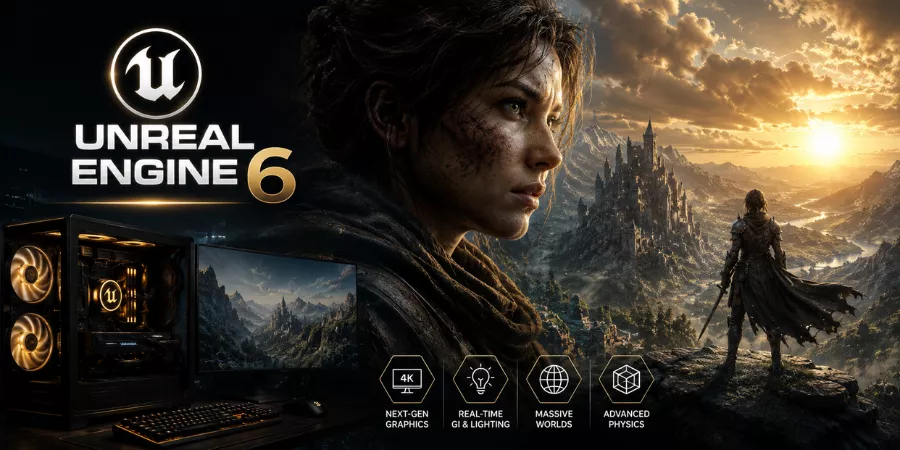
Unreal Engine 6 was officially unveiled on May 24, 2026, not at a developer conference, but during a Rocket League esports tournament in Paris. That timing alone tells you something about how Epic Games is thinking about this engine.
Here is everything confirmed, what to realistically expect, and whether your current PC is anywhere near ready.
What is Unreal Engine 6?
After years of speculation, Epic Games officially unveiled Unreal Engine 6. The announcement was made during the Rocket League Championship Series Paris Major 2026, where Epic confirmed that Rocket League will become one of the first major titles transitioned onto the new engine.
According to prior comments from Epic Games CEO Tim Sweeney, Unreal Engine 6 is intended to unify traditional Unreal Engine development with the creator-focused toolsets powering Unreal Editor for Fortnite (UEFN).
In simple terms: UE6 is not just a graphical upgrade. Epic wants it to become a unified platform where games, creators, assets, and communities connect across experiences, think Fortnite, LEGO Fortnite, Rocket League, and future titles all sharing the same foundational infrastructure.
Unreal Engine 5 was revealed in May 2020 and officially released in April 2022. UE6 follows four years later in announcement, but it is a long way from your hard drive yet.
When is Unreal Engine 6 Coming Out?
At UNREAL FEST in Japan, CEO Sweeney stated that a preview build would be available in “two to three years,” making a full release in 2028 likely. Foreign media outlets noted that “this reveal is less of a launch announcement and more of a signal that development has begun.”
The teaser landed as a signal that the engine is moving from private development into view, even though Epic gave no release date or technical sheet.
So to be direct: no release date, no technical specs, no launch roadmap. What Epic has shown is a direction and a teaser. The full engine is years away.
What Has Epic Confirmed About UE6?
Here is every officially confirmed detail, separated clearly from speculation.
Confirmed by Epic:
Epic said the core focus of Unreal Engine 6 is a comprehensive enhancement of creative tools, along with higher tick rates, improved graphics, real-time hotfixes, and a social engine that brings community hubs and forums directly into the game.
Epic Games CEO Tim Sweeney has mentioned its next-gen Unreal Engine 6 technology saying it will unify the parallel development threads the developer is currently working on. We should expect plenty of upgrades under the hood of UE6, with a big upgrade to multi-threaded performance and removing core limitations that have been inside Unreal Engine for multiple generations now.
What the teaser showed visually:
Based on the teaser showcased to fans worldwide, Rocket League’s run on the new Unreal Engine 6 features crisper images, cleaner details, more dynamic lighting, and reflective surfaces, among many others.
What has NOT been confirmed:
- No official system requirements
- No specific rendering features beyond what is listed above
- No release date
- No public developer access programme
- No pricing or licensing changes
Why Did Epic Reveal UE6 Through Rocket League?
Instead of giving players the Unreal Engine 5 upgrade they were asking for, the studio will be skipping it and heading straight to Unreal Engine 6.
Rocket League has been running on the same engine since 2015. It was one of the most requested upgrades in the game’s community. By choosing an esports event, watched by millions of competitive gaming fans, Epic sent a signal directly to a young, tech-aware audience rather than leading with a developer conference announcement.
One big thing we still do not know is whether this UE6 version will ship as an update to the existing game or as a fully separate Rocket League 2. Epic and Psyonix have not said a word about that yet, but for now, the conversation around Rocket League has not been this loud in a very long time.
The Rocket League UE6 upgrade is itself likely years away. Unreal Engine 6 is set to arrive in 2028, which means that Rocket League will have to wait a little longer for its massive overhaul.
What Problems is UE6 Trying to Fix From UE5?
Why Do So Many UE5 Games Stutter?
This has been the most consistent criticism of Unreal Engine 5 games since 2022.
Shader compilation stuttering happens when a render engine discovers that it needs to compile a new shader right before it uses it for drawing something, so everything stops while waiting for the driver to finish compilation.
Unreal Engine 5 games are particularly bad at this. The engine introduced new features like Nanite and Lumen that generate tons of shader variations. More variations mean more compilation, which means more stuttering. The Callisto Protocol, Remnant II, and Immortals of Aveum all launched with terrible shader compilation stuttering.
Epic Games recognizes that shader compilation stuttering is an issue in Unreal Engine 5 games and is working on fixes. It also advises developers to use the latest engine version, profile PSO hitches regularly, and clear the driver cache before playtests.
On top of shader stuttering, UE5 uses dynamic asset streaming, it loads textures and models when needed. If the configuration of these systems is not optimized, pop-in and slowdowns can be observed.
The Single-Thread Bottleneck
The single most credible technical claim about UE6 is multi-threaded gameplay simulation. This is the kind of foundational change that takes years to ship correctly, it requires rethinking actor tick ordering, replication, garbage collection interaction, and a long tail of subsystems.
In simpler terms: UE5, like earlier versions of Unreal Engine, still relies heavily on a single CPU thread for core game simulation. Modern CPUs have 8, 12, 16, even 24 cores, but UE5 cannot fully use all of them for gameplay logic. UE6 is being designed from the ground up to change that. This would be the most significant architectural upgrade in the engine’s history.
What Are the UE6 System Requirements?
Honest answer: nobody knows yet. Epic has released no official UE6 system requirements because the engine is not close to public release.
What we can do is look at where UE5 sits today and reason forward from there.
Official UE5 minimum requirements (from Epic’s documentation):
| Component | Minimum | Recommended for Nanite/Lumen |
| OS | Windows 10 64-bit | Windows 10/11 64-bit |
| CPU | Quad-core Intel or AMD, 2.5 GHz+ | 6-core+ modern CPU |
| RAM | 8 GB | 32–64 GB |
| GPU | DirectX 11 compatible | NVIDIA RTX 2080 / AMD RX 6600 XT or better |
| Storage | SSD recommended | NVMe SSD |
| DirectX | DirectX 11 | DirectX 12 |
You can launch the editor on 8 GB, but you’ll quickly hit memory limits. Epic’s own guidelines recommend 32 GB RAM for smooth development, and hardware experts suggest 64 GB for projects that involve light baking.
What this means for UE6 games:
Since UE6 is designed around multi-threaded performance and enhanced graphics beyond UE5, it is reasonable to expect that the bar will move upward. Based on what Tim Sweeney has described, higher tick rates, improved real-time rendering, a social engine layer, the practical requirements for running UE6 games well will likely push toward:
- A modern multi-core CPU (8+ cores), to actually benefit from the multi-threading improvements.
- 16-32 GB RAM as a realistic minimum for gaming.
- A mid-to-high-end GPU with ray tracing support.
- Fast NVMe storage, critical for the kind of asset streaming UE6 will likely demand
These are informed estimates based on UE5’s known requirements and UE6’s stated goals. They are not official figures.
What UE6 Games Are Coming?
Epic also teased future integrations involving Fortnite, LEGO Fortnite, UEFN, and other projects tied to its growing metaverse-style ecosystem ambitions.
Beyond Epic’s own titles, the broader question is which third-party studios will build on UE6. Perhaps games like The Witcher IV from CD Projekt Red will ship on Unreal Engine 6 instead of UE5, since they’re still far off from release. That is speculation, CDPR has not confirmed this, but it illustrates how far-future UE6 games are.
Currently confirmed or strongly indicated UE6 games:
- Rocket League (confirmed, timeline TBD, likely post-2028)
- Fortnite (strongly indicated by teaser)
- LEGO Fortnite (indicated in teaser)
Everything else is unconfirmed.
UE5 vs UE6: What We Know So Far
| Feature | Unreal Engine 5 | Unreal Engine 6 |
| Release | April 2022 | ~2028 (estimated) |
| Threading | Primarily single-threaded game sim | Multi-threaded game simulation (confirmed goal) |
| Shader stuttering | Known issue, partial fixes | Targeted for improvement |
| Tick rate | Standard | Higher tick rates (confirmed) |
| Hotfixes | Standard patching | Real-time hotfixes (confirmed) |
| Social layer | None built-in | Social engine with community hubs (confirmed) |
| Ecosystem | UE and UEFN separate | Unified UE + UEFN platform (confirmed goal) |
| Key tech | Nanite, Lumen, Chaos | Builds on UE5 tech – specifics not announced |
Is Your PC Ready for Unreal Engine 6 Games?
The straightforward answer is: you have time.
UE6 games will not arrive until at minimum 2028, and major third-party titles built on UE6 will likely come later than that. The hardware that ships between now and then, GPUs, CPUs, storage, will define what UE6 actually demands at launch.
That said, if you are planning a PC build or upgrade in the next 12–24 months, here is practical guidance based on where things are heading:
- CPU: Aim for 8 cores minimum. The multi-threading improvements in UE6 will reward modern CPUs with high core counts significantly more than UE5 does.
- RAM: 32 GB should be the baseline for any future-facing gaming PC. UE5 already pushes 16 GB in demanding titles.
- GPU: An RTX 4070 or AMD RX 7800 XT class card is a sensible benchmark for where UE6 games will likely land at medium-to-high settings.
- Storage: An NVMe SSD is no longer optional for any engine in this category. Mechanical hard drives are not a realistic option.
Frequently Asked Questions
What is Unreal Engine 6? Unreal Engine 6 is Epic Games’ next-generation game engine, officially announced on May 24, 2026. It is designed to unify Unreal Engine development with the Fortnite creator platform, add multi-threaded gameplay simulation, higher tick rates, real-time hotfixes, and a built-in social engine. No release date has been announced. A preview build is expected around 2028.
When does Unreal Engine 6 come out? Epic CEO Tim Sweeney said at UNREAL FEST Japan that a preview build would be available in “two to three years,” pointing to approximately 2028. No official launch date has been confirmed.
What is Rocket League UE6? Rocket League was announced as one of the first games to move to Unreal Engine 6, revealed during the RLCS Paris Major 2026. It will receive improved graphics, lighting, reflections, and car customisation. Whether it ships as an update to the existing game or as a separate Rocket League 2 has not been confirmed.
What are the Unreal Engine 6 system requirements? Epic has not published official UE6 system requirements. Based on UE5’s requirements and UE6’s confirmed goals, expect a modern multi-core CPU, 16-32 GB RAM, a ray-tracing capable GPU, and an NVMe SSD to be realistic targets. Official specs will come closer to the engine’s release.
What problems will UE6 fix compared to UE5? The confirmed priorities include fixing the single-threaded performance bottleneck that limits how modern multi-core CPUs are used, addressing shader compilation stuttering that has plagued UE5 games since 2022, and adding real-time hotfix support so games can be patched without full updates.
Will my current gaming PC run UE6 games? If you have a PC built in the last two to three years with a modern GPU and 16+ GB RAM, you likely have the foundation. UE6 games are still years away. Hardware will continue improving between now and then. There is no need to upgrade specifically for UE6 today.
Key Takeaways
- Unreal Engine 6 was officially revealed May 24, 2026 at the RLCS Paris Major, Rocket League is the first confirmed UE6 title.
- A preview build is expected around 2028, this is not an imminent release.
- Confirmed UE6 features: multi-threaded gameplay, higher tick rates, real-time hotfixes, social engine, unified UE and UEFN platform.
- UE6 directly targets UE5’s biggest weakness, shader compilation stuttering and single-threaded CPU bottlenecks.
- No official UE6 system requirements exist yet, plan for a modern multi-core CPU, 32 GB RAM, and a ray-tracing capable GPU.
- The announcement is a signal that Epic’s next platform shift has begun, not a product you can download today.