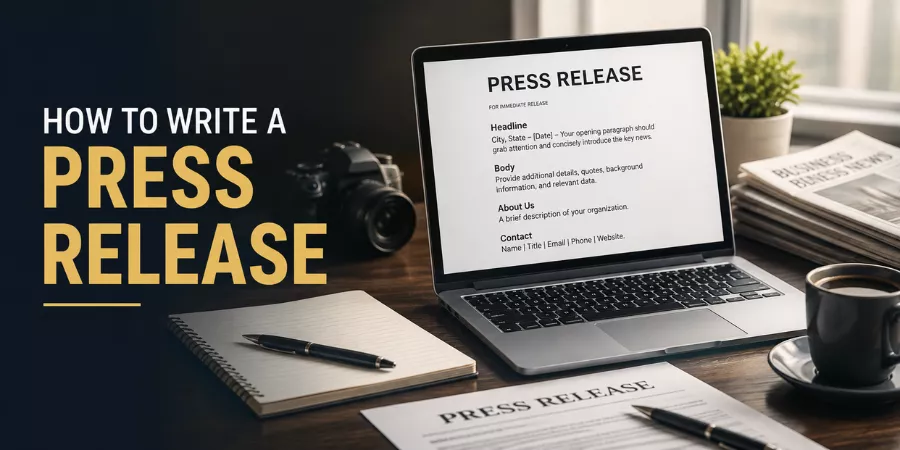
A press release is a short, factual document a company or individual sends to journalists to announce something newsworthy. It follows a specific structure, headline, dateline, lead paragraph, supporting information, quote, boilerplate, and contact details, and is written in the third person, as a journalist might write it. A good press release answers the 5 W’s in the first paragraph and puts the most important information first.
That last point is the one most people get wrong. A press release is not a company announcement. It is a document written for a journalist who has 200 unread emails and no obligation to read yours. Write it accordingly.
66% of journalists rely on PR-provided content, including press releases, pitches, and media kits, as their leading source for story ideas. Furthermore, past editions of the report consistently show that 74% of journalists explicitly want to receive news announcements and press releases directly from PR professionals. The format works, when it is done properly.
How Do You Write a Press Release?
1. Decide Whether Your News Is Worth a Press Release
Not every announcement deserves a press release. Sending weak news to journalists wastes their time and damages your credibility for future pitches. Before writing anything, run the announcement through four questions:
- Is it genuinely new?
- Does it affect people outside the company?
- Is there a clear public or industry impact?
- Would a journalist have a reason to cover it?
Strong press release material: a product launch with quantifiable impact, a funding round above a meaningful threshold, a significant executive hire, a research finding, a merger or acquisition, a crisis response.
Weak press release material: a website redesign, a new office layout, an internal promotion nobody outside the company recognizes, an award from an organization nobody has heard of.
The honest test: would a journalist at a relevant publication find this interesting on its own merits, not because you sent it, but because their readers would care?
2. Choose the News Angle
The announcement is not the angle. The impact is.
Most companies write press releases about what they did. Journalists write stories about why it matters. The press release needs to make that jump before it lands in anyone’s inbox.
Weak angle:
ABC Company Launches New Accounting Software
Stronger angle:
ABC Company Launches Software That Cuts Small Business Bookkeeping Time by 50%, Targeting 33 Million Self-Employed US Workers
The second version tells the journalist the story in one line. The first one makes them work for it. They will not.
Finding the angle means asking: who benefits from this, by how much, and why now? The answers to those three questions are your news angle.
3. Write a Clear Headline
A press release headline has one job: tell the journalist what happened and why it matters, in under 15 words, without exaggerating.
No superlatives, no marketing language, no vague promises. Just the news.
Examples:
- Fintech Startup Raises $40 Million to Expand Credit Access for Gig Economy Workers.
- City Council Approves Zero-Emission Bus Fleet, Replacing 200 Diesel Vehicles by 2028.
- Retailer Cuts Return Processing Time by 60% After AI Inventory Integration.
Each headline names a subject, states an action, and implies significance. That is the formula. The press release format lives or dies by the headline, it determines whether the journalist reads the rest.
4. Add the Dateline and Release Status
The dateline goes at the start of the first paragraph and tells the journalist when and where the news originates.
Standard format:
FOR IMMEDIATE RELEASE
NEW YORK, August 10, 2026
If the release is embargoed, meaning you are sending it before the official announcement and asking journalists not to publish until a specific time, state that clearly at the top:
EMBARGOED UNTIL 9:00 AM ET, AUGUST 12, 2026
Embargoes are a trust arrangement. Break them, or ask journalists to honor embargoes without giving them anything valuable in return, and they remember.
5. Write the Lead Using the 5 W’s
The lead paragraph is the most important part of any press release. It should contain everything a journalist needs to understand the announcement without reading further.
The formula: Who + What + When + Where + Why
Example lead:
Hinge Health, headquartered in San Francisco, is a digital musculoskeletal care provider, which has just launched a telehealth platform for physical therapy that will bring down the employer health plan spending on chronic pain treatments by 40% for all the company’s 1,000 US clients from now on.
That single sentence answers: who (Hinge Health), what (remote PT platform launch), when (today), where (US), why (40% cost reduction for employer plans).
Everything after the lead is supporting information. If the journalist only reads the first paragraph, and many will, they still understand the story.
6. Build the Body Using Descending Importance
This is the inverted pyramid structure that every journalism school teaches and most press release writers ignore.
Most important fact
↓
Supporting facts
↓
Quote from executive
↓
Evidence and details
↓
Background and context
↓
Boilerplate and contact
The reason for this structure is practical: journalists cut from the bottom up. If they use your release as the basis for a story, the boilerplate goes first. The background goes second. Your key facts need to survive the cuts.
Each paragraph in the body should advance the story. If a paragraph could be removed without losing anything important, remove it.
7. Add a Quote That Provides Insight
Quotes in press releases serve one function: adding perspective that cannot be captured in a factual sentence. They are not there to restate the announcement in enthusiastic terms.
Bad quote:
“We are incredibly excited to announce this groundbreaking product that will revolutionize how businesses manage their finances,” said CEO Jane Smith.
That quote tells the journalist nothing. It reads like marketing copy and will almost certainly be cut.
Better quote:
“Most small business owners spend eight to twelve hours a month on reconciliation. We built this to get that number under two hours,” said Jane Smith, CEO of ABC Company.
That quote explains the product’s purpose through a specific claim. It sounds like something a real person said. It is actually usable in a story.
The spokesperson should be the most relevant person, usually the CEO for company news, a product lead for a launch, a scientific director for the research finding. 80% of journalists say academic experts are the most credible sources, with CEOs dropping 12% in perceived credibility over the last two years, according to eReleases 2024. Match the spokesperson to the nature of the announcement.
8. Finish With the Boilerplate and Contact Details
The boilerplate is a short paragraph at the end describing the company. It should be factual, current, and under 100 words. It is the same paragraph used in every release.
After the boilerplate, include:
- Media contact name
- Job title
- Direct email
- Direct phone number
- Company website
End the release with three hash symbols (###) to signal the document is complete. This is a press release convention that every journalist recognizes.
What is the Standard Press Release Format?
A clean press release template looks like this:
FOR IMMEDIATE RELEASE
[CITY, DATE], [Lead paragraph with 5 W’s]
[Supporting paragraph, key facts]
[Quote from spokesperson]
[Second supporting paragraph, evidence, detail, context]
[Background paragraph]
###
About [Company Name]
[Boilerplate, 2–3 sentences describing the company]
Media Contact:
[Name]
[Title]
[Email]
[Phone]
[Website]
Stick to this press release format. It exists because it works. Journalists recognise it immediately and know how to use it. Deviating from it, using bullet points where prose belongs, adding design elements, restructuring the order, creates friction without benefit.
How Long Should a Press Release Be?
Between 300 and 500 words for most announcements.
It determines the reality of how journalists process information. A release that runs to 800 words is not more informative, it is harder to extract information from. Email open rates for press releases average around 25% in 2025, according to SEO Design Chicago, meaning the window to make an impression is narrow, and length works against you.
Complex announcements, research findings, major regulatory developments, detailed product launches, can run longer if the additional length carries actual information. Most do not. If a release exceeds 600 words, the likely reason is that the editing has not been done.
What Should You Include in a Press Release?
A complete press release includes:
- Headline: factual, specific, under 15 words
- Dateline: city and date at the start of the lead
- Release status: “For Immediate Release” or embargo details
- Lead paragraph: 5 W’s in one paragraph
- Supporting detail: facts, figures, context in descending importance
- Quote: one meaningful quote from the appropriate spokesperson
- Evidence: statistics, data, research references where relevant
- Relevant links: product page, research paper, announcement page
- Boilerplate: company description, 2–3 sentences
- Media contact: name, email, phone, website
- Images: available separately, not attached to the email
What are the Different Types of Press Releases?
| Type | Lead emphasis | Example angle |
| Product launch | Problem the product solves | Platform reduces hospital readmission rates by 22% |
| Funding announcement | Amount, investors, use of capital | Startup raises $60M Series B to expand into European markets |
| Event announcement | Who should attend and why | Annual cyber summit to host 2,000 security leaders from 40 countries |
| New executive hire | Why this person, why now | Former FDA director joins biotech to lead regulatory strategy |
| Partnership | Combined capability or market reach | Cloud providers combine infrastructure to serve 150 million new users |
| Acquisition | Strategic rationale, financial terms | Retailer acquires logistics startup to cut delivery times by 30% |
| Research or report | Key finding, who it affects | Study finds remote workers log 2.5 more hours daily than office counterparts |
| Award | Significance of recognition | Engineering firm named safest contractor in North America for third consecutive year |
| Crisis response | What happened, what is being done | Company recalls product, notifies affected customers, opens compensation process |
| Rebranding | Business reason for the change | Insurance group rebrands after expanding beyond auto coverage |
| Milestone | Scale of achievement, next step | Platform reaches 10 million users, targets international expansion in 2027 |
Each type follows the same structural rules. The only thing that changes is what the lead paragraph emphasises.
Press Release Examples
Product Launch
Headline: Hinge Health Launches AI Physical Therapy Tool That Reduces Opioid Prescriptions by 42%
Lead: Hinge Health, a San Francisco digital health company, today launched an AI-assisted physical therapy platform for employer health plans that the company says reduces new opioid prescriptions among musculoskeletal patients by 42% and cuts chronic pain program costs by 40%.
Quote: “Most people with back pain never see a physical therapist because it is not accessible or affordable. We built this to close that gap at scale,” said Daniel Perez, co-founder and CEO.
Why it works: The headline states the outcome, not the feature. The lead gives the 5 W’s in one sentence. The quote explains the purpose without restating the statistics.
Funding Announcement
Headline: Climate Tech Startup Raises $85 Million to Scale Industrial Carbon Capture Across North America
Lead: Carbon Clean, a London-based industrial decarbonization company, closed an $85 million Series C funding round today led by Breakthrough Energy Ventures, with plans to deploy carbon capture technology at 15 additional manufacturing facilities across the US and Canada by 2027.
Quote: “Manufacturing accounts for nearly a quarter of global carbon emissions. We are starting where the problem is largest,” said CEO Aniruddha Sharma.
Crisis Response
Headline: Retailer Issues Voluntary Recall of 45,000 Smart Heaters Following Overheating Reports
Lead: HomeTech recalled 45,000 Model HT-200 smart space heaters today after 23 customers reported overheating incidents, including three minor injuries. The company is offering full refunds and free shipping labels for all affected units purchased between January 2024 and July 2026.
Quote: “Customer safety is not negotiable. We stopped production immediately and are contacting every registered owner directly,” said CEO Maria Lindqvist.
Why it works: No hedging, no corporate softening. The facts are stated clearly. The quote confirms action without sounding defensive.
Press Release vs. Media Pitch: What Is the Difference?
These are two separate documents that serve different purposes and are used together:
| Feature | Press Release | Media Pitch |
| Format | Formal structured document | Short personalised email |
| Purpose | Contains the complete announcement | Explains why this journalist should care |
| Audience | Any journalist who receives it | One specific journalist |
| Reusability | Used across all media contacts | Written fresh for each contact |
| Length | 300–500 words | 150–200 words |
| Content | All facts, quotes, boilerplate | Context, angle, journalist relevance |
The pitch goes in the email body. The press release follows, either pasted below or linked, depending on the journalist’s preference. Nearly 90% of PR professionals prefer one-on-one email pitches for story submissions, according to SEO Design Chicago 2025. Mass-sending the same press release to a distribution list without a personalised pitch is the fastest way to be ignored.
How to Send a Press Release to Journalists
Find Relevant Journalists
Relevance means beat, not publication. A technology journalist at a local newspaper may cover your story better than a generalist at a national outlet. Look at what each journalist has covered in the past three months. If your announcement fits naturally into their recent work, they are the right target.
Write a Personalised Pitch Email
The subject line should read like a headline. The body should explain in two or three sentences why this story matters to their specific audience. Reference their recent work if it is genuinely relevant, not performatively.
Paste the Release, Do Not Attach It
Most journalists will not open an attachment from an unknown sender. Paste the press release below your pitch email. If the release includes images, provide a download link rather than attaching files.
Follow Up Once
One follow-up, 48 to 72 hours after the initial send. One line: are you interested in covering this? If they do not respond, that is an answer.
Respond Fast When Journalists Reply
A journalist asking a follow-up question often has a deadline measured in hours. Slow responses lose coverage. Have a spokesperson available and brief them before the release goes out.
Thursday is the best day to send a press release, with email open rates jumping above 26%, according to eReleases 2024. Tuesday and Wednesday also perform well. Avoid Mondays, Fridays, and any day adjacent to a major holiday.
Common Press Release Mistakes to Avoid
- No genuine news value: The most common mistake. An internal appointment, a new website, a rebranded logo, these are rarely press release material. Ask whether a journalist would cover this independently. If the honest answer is no, do not send it.
- Burying the lead: Putting the actual news in the second or third paragraph. Journalists do not hunt for the point.
- Vague headline: “Company Announces Exciting New Product” tells the journalist nothing. Specificity is credibility.
- Promotional tone: Words like “revolutionary,” “industry-leading,” and “innovative” signal a PR document, not a news document. Remove them all.
- Quotes that restate statistics: If the quote is “We are proud to announce that this product reduces costs by 40%,” the quote is doing nothing the surrounding text does not already do. Quotes should add perspective, not repetition.
- Industry jargon: Write for a journalist, not for a conference audience. If a term needs explaining, either explain it briefly or replace it.
- Sending to irrelevant contacts: A food industry journalist does not need your enterprise software announcement. Targeting precision matters more than distribution volume.
- No contact details: Surprisingly common. If a journalist cannot reach a human being quickly, the story dies.
- Typos or factual errors: One factual error in a press release poisons the entire announcement. Verify every name, title, figure, and date before sending.
How to Make a Press Release More Newsworthy
The press release format is not the hard part. Newsworthiness is.
- Add original data: Proprietary research, internal survey findings, or platform data turns a standard announcement into a story with independent value. 72% of journalists rely on press releases for story ideas, according to Meltwater’s Journalist Survey, but they are far more likely to use releases that bring something they cannot find elsewhere.
- Quantify the impact: “Significant improvement” means nothing. “38% reduction in processing time across 12,000 enterprise clients” means something.
- Connect to a current issue: A product launch that addresses a problem currently in the news travels further than an isolated announcement. If your logistics software launches during a supply chain crisis, lead with the crisis.
- Include a credible third-party voice: An independent analyst, academic researcher, or customer spokesperson adds credibility that your own executives cannot provide.
- Explain who benefits and who is affected: News is about people. If the announcement has a human dimension, workers, patients, consumers, a specific community, that is the lead, not the corporate milestone.
Press Release Checklist
Before sending any press release, confirm the following:
- Does the announcement have genuine news value?
- Is the headline factual, specific, and under 15 words?
- Does the first paragraph answer who, what, when, where, and why?
- Is information arranged from most to least important?
- Does the quote add genuine insight, not repeat what the surrounding text already says?
- Have all promotional and superlative language been removed?
- Is the release between 300 and 500 words?
- Are all names, dates, figures, and links accurate and verified?
- Is the boilerplate current and accurate?
- Is there a named media contact with a working email and phone number?
- Are images available via a download link, not as attachments?
- Has the journalist list been checked for beat relevance?
- Has the pitch email been personalised for each contact?
- Is a spokesperson available and briefed for follow-up questions?
Press Release FAQ
What is a press release?
A press release is a formal written announcement sent to journalists and media outlets. It follows a specific structure, headline, dateline, lead, supporting information, quote, boilerplate, contact details, and is written in the third person. It tells journalists what happened, why it matters, and who to contact for more information.
What should a press release include?
A headline, dateline, release status, 5-W lead paragraph, supporting facts in descending importance, one meaningful quote, a boilerplate company description, and complete media contact information.
How long should a press release be?
300 to 500 words for most announcements. Complex research findings or detailed product launches may run to 600 words. Longer than that is almost always a sign the editing has not been done.
What are the 5 W’s in a press release?
Who, what, when, where, and why. Every lead paragraph should answer all 5. After reading the first paragraph, a journalist should understand the complete announcement without reading further.
Should a press release be written in first person?
No. Press releases are written in the third person, the same way a journalist would write a news story. The only first-person language appears inside quotations from named spokespeople.
Should a press release include a quote?
Yes, one quote from a relevant spokesperson, placed in the middle of the release. The quote should provide perspective or explanation that the surrounding factual text cannot.
Should you attach a press release to an email?
Generally, no. Paste the press release into the body of the email below the pitch. If the release includes images or supporting documents, provide a download link rather than an attachment.
What is the difference between a press release and a media pitch?
A press release contains the complete announcement in a structured format. A media pitch is a short, personalised email explaining why a specific journalist should care about that announcement. They are different documents used together.
When should you send a press release?
Thursday has the highest open rates for press release emails, above 26%, according to eReleases 2024. Tuesday and Wednesday also perform well. Send in the morning, before 10 AM local time for the journalist’s timezone.
How do you send a press release to journalists?
Identify journalists by beat and recent coverage. Write a personalised two-to-three sentence pitch email with the release pasted below. Follow up once, 48 to 72 hours later. Have a spokesperson briefed and available for rapid response if a journalist replies with questions.
Conclusion
Learning how to write a press release is not complicated. The format is established, the structure is logical, and the rules are consistent. What is genuinely difficult is writing one that a journalist will use.
That difficulty comes down to one question: is this actually news? A well-formatted press release built around a weak announcement will not get coverage. A slightly imperfect release built around a genuinely newsworthy story usually will.
68% of businesses that regularly issue press releases report improved media visibility, according to Cision’s 2024 research. The format remains one of the most trusted and effective tools in PR writing, when the news behind it is real, the structure is clean, and the journalist receiving it has a genuine reason to care.
Start there. Everything else follows.