A brand can be mentioned thousands of times in a week and still have no clear idea what people actually think about it.
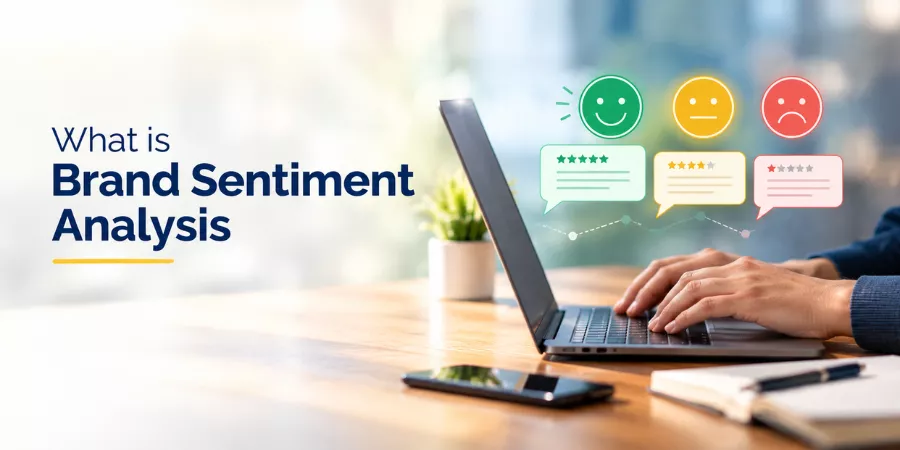
Brand sentiment analysis helps fill that gap. It looks at conversations about a company, product, service or campaign and identifies the tone behind them, usually as positive, negative or neutral. Modern tools can go further by identifying emotions, topics, intent and changes in sentiment over time.
For PR teams, this makes sentiment analysis more useful than simply counting media mentions. A campaign might generate huge attention while customer frustration rises at the same time. A product launch might receive fewer mentions but produce a much more favorable conversation.
The useful question is therefore not simply “How much are people talking about us?” It is “What are they saying, what is driving the reaction, and what should we do about it?”
What is Brand Sentiment Analysis?
Brand sentiment analysis is the process of measuring the emotional tone and opinions expressed about a brand across online conversations and other forms of audience feedback.
The data can come from social media posts, online reviews, forums, news coverage, blogs, surveys, customer-service conversations and other text-based sources. Sentiment analysis software uses natural language processing and machine learning to classify that material and identify patterns at a scale that would be difficult for a human team to handle manually.
The simplest classification looks like this:
- Positive: praise, satisfaction, excitement or favorable opinions
- Neutral: factual mentions without a clear positive or negative tone
- Negative: complaints, disappointment, criticism or anger
More sophisticated systems are able to detect emotions like frustration, happiness or irritation and match them to particular topics or themes.
Why Does Brand Sentiment Matter for PR?
Brand sentiment offers PR teams an indicator of how public response is evolving, on top of volume of coverage.
Suppose a company advertising for a new product feature. There is a ton of press with twice as many social mentions. At first glance, it all looks good.
But sentiment analysis shows something else: most of the negative conversation is about the product’s price. That finding gives the communications team a much more specific problem to work with. The team can clarify pricing, address customer concerns, brief spokespeople and adjust future messaging.
This is where sentiment analysis becomes useful for PR measurement, reputation management and crisis communications. Cision describes sentiment as a way to add context to brand mentions and media monitoring rather than treating every mention as equally valuable.
How Does Brand Sentiment Analysis Work?
Most brand sentiment analysis follows four basic stages: collect the conversation, analyze the language, classify the sentiment and identify the pattern.
- Collect brand mentions
The system gathers relevant conversations from the sources covered by the platform.
Depending on the tool, this can include:
- Social media
- Online news
- Reviews
- Forums
- Blogs
- Podcasts
- Broadcast media
- Customer feedback
The initial hurdle is gathering the right data. If significant conversations are not captured, the sentiment image will be inaccurate.
- Analyze the language
NLP Analyzing words and context to know the possible feelings. More recent “neural network systems” are more and more using machines rather than just searching for key words.
- Assign sentiment
The software generally categorizes mentions as positive, negative or neutral. Some platforms add emotion categories and topic-level analysis.
- Look for changes
The real value usually appears when sentiment is viewed over time. A single negative comment tells you very little.
A sudden increase in negative sentiment around delivery delays, customer service or product quality tells you considerably more.
When a developing issue requires a timely public response, PR teams can also use reactive PR to respond to relevant news, emerging conversations or reputation issues with verified information and expert commentary.
What is the Difference Between Brand Sentiment and Brand Awareness?
Brand awareness measures whether people recognize or mention a brand; brand sentiment looks at how they feel about it.
The two metrics can move in completely different directions.
A controversial campaign could dramatically increase brand awareness while damaging sentiment. A quiet product improvement might generate little publicity but lead to better customer reactions.
This is why brand mentions, reach and impressions should not be treated as substitutes for sentiment. Cision similarly separates the volume of conversation from the feeling attached to that conversation.
What is the Difference Between Social Listening and Sentiment Analysis?
Social listening is the broader process; sentiment analysis is one of the ways teams interpret what they find.
Social listening can reveal:
- What people are discussing
- Which topics are gaining attention
- Who is driving the conversation
- Where conversations are happening
- What competitors are being mentioned
- How audiences feel about a subject
Sentiment analysis adds an emotional layer to that information.
A PR team might use social listening to discover that customers are discussing a new return policy. Sentiment analysis can then show whether those conversations are mostly favorable, neutral or negative.
Hootsuite’s 2026 guidance similarly distinguishes social listening from simple monitoring by emphasizing patterns, context and sentiment rather than only collecting mentions.
What Are the Best Brand Sentiment Analysis Tools?
The best sentiment analysis tool depends on the channels you need to monitor, the size of your dataset and how closely you want sentiment data connected to PR, marketing or customer experience workflows.
Some widely used platforms in the 2026 market include:
| Tool | Useful for | Notable capability |
| Brandwatch | Consumer research and PR | Social listening, sentiment, emotion and visual analysis |
| Meltwater | PR and media monitoring | Media, social and broader reputation intelligence |
| Hootsuite | Social teams | Sentiment alongside social listening and publishing |
| Talkwalker | Global brand monitoring | Cross-channel listening and visual intelligence |
| Sprinklr | Enterprise teams | Social, customer experience and AI-powered insights |
| Cision | PR and communications | Media monitoring and sentiment analysis |
| YouScan | Consumer and visual intelligence | Social listening and image recognition |
| Brand24 | Smaller teams | Brand monitoring and sentiment tracking |
Current 2026 tool comparisons from Meltwater, Hootsuite and Sprout Social show that the market ranges from dedicated social-listening products to larger platforms combining media monitoring, customer data and sentiment analysis.
Do not choose a platform solely because it has the largest feature list. Check whether it actually covers the places where your customers and stakeholders talk about you.
How Do You Measure Brand Sentiment?
Start with sentiment by channel, topic and time period rather than relying on one overall score.
A basic sentiment percentage can be calculated as:
Positive sentiment rate = positive mentions ÷ total analyzed mentions × 100
You can also calculate net sentiment:
Net sentiment = positive mentions − negative mentions ÷ total mentions × 100
For practical PR reporting, however, the number alone is not enough.
Track:
- Positive, negative and neutral mentions
- Sentiment trend over time
- Sentiment by channel
- Sentiment by campaign
- Sentiment by topic
- Share of voice
- Volume of mentions
- Reach or potential exposure
- Sources driving negative conversation
- Key themes behind positive and negative reactions
The reason behind a sentiment change is often more useful than the score itself.
What is a Good Example of Brand Sentiment Analysis?
Consider a fictional skincare company launching a new moisturizer.
During the first week:
- Brand mentions rise 70%.
- Positive sentiment increases around the product’s texture.
- Negative sentiment rises around shipping delays.
- Neutral mentions come mostly from media reviews.
- Most negative posts originate from customers waiting more than a week for delivery.
Looking only at mention volume, the launch appears successful.
Looking at sentiment by topic, the problem becomes obvious: the product may be performing well while fulfillment is creating the reputational problem.
The PR team now has a much clearer job. It can coordinate with customer service, explain the delay, provide accurate delivery information and make sure future communications do not promise faster shipping than the company can deliver.
That is the practical value of sentiment analysis: it can turn a large volume of conversation into a more specific communications problem.
Can Brand Sentiment Analysis Help With Crisis Communications?
Yes. It can help PR teams detect unusual changes in public reaction and identify what is driving them.
A sudden spike in negative mentions can act as an early warning signal. The cause might be a product problem, executive statement, viral complaint, misleading headline, customer-service issue or unrelated event involving the brand.
But sentiment analysis should not be treated as an automatic crisis detector.
A spike needs to be investigated.
Look at the actual posts and articles behind the change. Check whether the conversation is coming from customers, journalists, influencers, bots or unrelated accounts. Then establish what happened before deciding how to respond.
AI sentiment tools can process large amounts of information quickly, but automated classification still has weaknesses around context, irony, sarcasm and ambiguous language.
What Are the Biggest Problems With Brand Sentiment Analysis?
The biggest problem is assuming that a sentiment score is a perfect reading of public opinion. It is not.
Human language is messy.
Someone can write: “Fantastic. Another three days waiting for my order.”
A basic system may see “fantastic” and classify the comment as positive. A human immediately recognizes the sarcasm.
Research and current technical guidance continue to identify sarcasm, context, negation and ambiguity as difficult problems for automated sentiment systems.
There are other issues too.
- Mixed opinions: A customer may love the product but dislike the price. One post can therefore contain both positive and negative sentiment.
- Different languages and cultures: Expressions, slang and humor vary between markets. A model that performs well in one language or variety of English may not perform equally well elsewhere. Recent IBM research specifically highlights challenges around linguistic diversity in sentiment and sarcasm detection.
- Volume can be misleading: A large number of posts does not automatically mean a large number of genuine customers.
- Context can disappear: A short social post may make sense only when read alongside the conversation that came before it.
For these reasons, PR professionals should use sentiment analysis to find patterns, then inspect the underlying conversations before making major decisions.
How Should PR Teams Use Brand Sentiment Analysis?
Use sentiment data to guide questions and actions, rather than treating it as the final answer.
A practical PR workflow looks like this:
Monitor → detect change → identify topic → read the conversation → verify the facts → respond → measure the result.
For example, if negative sentiment suddenly rises, ask:
- What changed?
- When did it start?
- Which channel is driving it?
- What topic appears most often?
- Who is talking about it?
- Is the conversation organic or amplified by a small group?
- Is there a factual problem that needs correcting?
- Does the issue require a public response?
- Has the response changed the conversation?
This prevents a common PR mistake: responding to the number before understanding the story behind it.
For a broader look at how businesses use public relations across media relations, product launches, thought leadership, crisis communications and reputation management, see our guide to PR examples.
How Can You Improve Negative Brand Sentiment?
First identify the reason for the negative reaction; then decide whether the answer is communication, operational change or both.
- If customers are angry because information is unclear, better communication may help.
- If customers are angry because a product is genuinely defective, a polished PR statement will not solve the underlying problem.
- If criticism comes from inaccurate information, factual clarification may be appropriate.
- If the problem is a customer-service failure, the PR team may need to work with the customer experience team rather than handling the issue as a communications problem alone.
This is where sentiment analysis becomes more valuable when combined with topic analysis, customer feedback, media monitoring and business data.
How Often Should You Monitor Brand Sentiment?
The right frequency depends on how quickly the conversation around your brand changes.
For an established brand with relatively stable conversation, weekly or monthly reporting may be sufficient for strategic analysis.
During a product launch, major announcement or developing reputation issue, monitoring should be much more frequent.
PR teams dealing with fast-moving situations need to see changes as they happen rather than discovering them in a report several weeks later.
Hootsuite and other current social-listening platforms emphasize continuous monitoring because sentiment can shift quickly following campaigns, product launches and external events.
What Should a Brand Sentiment Report Include?
A useful brand sentiment report should explain what happened, why it happened and what the team should watch next.
Include:
- Reporting period
- Total brand mentions
- Positive, negative and neutral sentiment
- Change from the previous period
- Sentiment by channel
- Top positive themes
- Top negative themes
- Important conversations
- Major media coverage
- Competitor comparison where relevant
- Campaign-related changes
- Recommended follow-up actions
Avoid filling the report with charts that do not lead to a decision.
A PR director usually needs to know what changed, what caused the change and what needs attention next.
What is the Best Way to Use Brand Sentiment Analysis in PR?
Brand sentiment analysis works best when it is treated as evidence, not a verdict.
The technology is excellent at processing large amounts of conversation quickly. It can surface patterns that would be difficult for a communications team to spot manually. But it does not replace human judgment, especially when a conversation involves sarcasm, cultural context, mixed opinions or a developing crisis.
For PR teams, the most useful approach is simple:
- Track sentiment alongside mention volume.
- Break sentiment down by topic and channel.
- Watch for unusual changes rather than obsessing over one score.
- Read the conversations behind major spikes.
- Separate genuine audience reaction from noise.
- Connect negative sentiment to the underlying business issue.
- Measure whether communications changed the conversation.
The strongest brand sentiment analysis does not end with a dashboard. It gives a communications team a clearer picture of what people are reacting to and enough context to decide what deserves a response.
Why Choose The Press Wires?
For businesses and PR teams, getting a press release published is only one part of building visibility. The next step is getting that announcement in front of a wider audience and creating measurable exposure around important company news.
The Press Wires provides a platform for distributing press releases and business news, helping brands share product launches, company announcements, partnerships, events, executive updates and other newsworthy developments.
If you have a company announcement ready to share, you can submit your press release to The Press Wires and put your news in front of a broader online audience. Publishing your announcement also gives your PR team another source of coverage to monitor when evaluating audience response and brand sentiment.
Ready to distribute your next announcement? Submit your press release to The Press Wires today and start building visibility around your brand news.