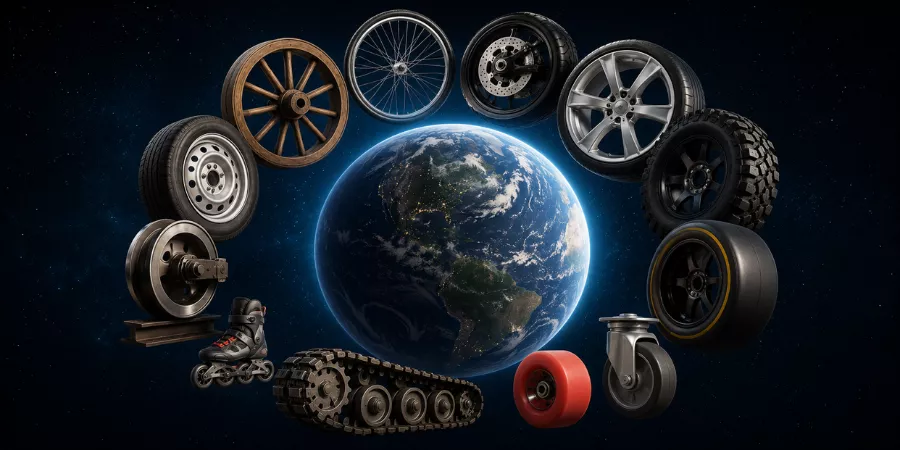
There are approximately 37 to 42 billion wheels in the world right now. That number grows by billions every single year, from cars rolling off production lines, bicycles being assembled, toys being manufactured, and office chairs being shipped to warehouses across the world.
Most people, when they hear this question, immediately think of cars. That is only the beginning.
5 things this article covers:
- What a wheel actually is and why it matters to the count
- Where the world’s billions of wheels actually come from
- How many wheels are added to the world per year
- Whether there are more wheels or doors in the world
- Why bicycles alone contribute over 3 billion wheels globally
What Even is a Wheel?
Before counting, you need to know what you are counting.
A wheel is a circular object that rotates around a central point called an axle. It converts rotational force into movement or transfers load. That is the full definition, and it covers far more than most people picture.
A wheel is not just what you see on a car. It includes:
- The rubber-tyred wheels on your car, bike, and motorcycle
- The small plastic casters on your office chair
- The spinner wheels on your suitcase
- The tiny wheels on a LEGO car or a Hot Wheels toy
- The wheels on a shopping trolley, hospital bed, skateboard, and lawnmower
- The wheels inside industrial machinery and conveyor belts
- The wheels on aircraft landing gear
Once you understand the full scope of what counts, the number stops feeling like an exaggeration. 37 to 42 billion starts to feel like it might actually be conservative.
Different Types of Wheels
Pneumatic Wheels (Air-Filled Tyres)
These are what most people picture when they hear the word “wheel.” A pneumatic wheel has a rubber tyre filled with air, which sits around a hard rim, usually made of steel or aluminium alloy. The air inside absorbs shock and gives the vehicle grip on the road.
Found on: cars, bicycles, motorcycles, trucks, buses, tractors, aeroplanes
A pneumatic tyre was first created by John Boyd Dunlop in 1888, in the form of a bicycle wheel. Popularity has grown and pneumatic tyres are now the most commonly found wheel on cars lorries buses trains planes and any other wheeled mode of transport. The worldwide tyre industry supplies an approximate 2 000 000, 000 tyres a year, with the market sector valued at over $200 billion (Statista).
Solid Rubber Wheels
These have no air inside. The rubber is dense and vulcanised, meaning it holds its shape under heavy loads without the risk of puncture. They are slower and less comfortable than pneumatic wheels but virtually maintenance-free.
Found on: forklifts, warehouse equipment, wheelchairs, industrial trolleys, lawnmowers
Solid rubber wheels are one of the most common wheel types in industrial and logistics environments. Every warehouse, factory, and distribution centre in the world runs on them.
Caster Wheels
A caster is a small wheel mounted in a swivel housing, which allows it to rotate 360 degrees. This means the object it is attached to can move in any direction without being lifted or turned.
Found on: office chairs, hospital beds, shopping trolleys, suitcases, furniture dollies, IV stands
Caster wheels are arguably the most numerous wheel type in the world. With roughly 1 billion office chairs each carrying 5 casters, office furniture alone accounts for approximately 5 billion caster wheels globally, before you count hospital equipment, retail trolleys, or cabinetry.
Spoked Wheels
A spoked wheel uses thin rods, called spokes, radiating out from a central hub to the outer rim. The spokes distribute weight and absorb stress more efficiently than a solid disc, which is why spoked wheels are lighter and stronger per unit of material than solid alternatives.
Found on: bicycles, motorcycles, vintage cars, horse-drawn carriages, some sports wheelchairs
The spoked wheel design dates back to around 2000 BCE, when Egyptian chariot makers discovered it allowed faster, lighter vehicles. Modern bicycle spoked wheels can carry several times the rider’s body weight despite weighing less than a kilogram.
Alloy and Steel Rims (Car Wheels)
Modern car wheels are either pressed steel or cast alloy, typically aluminium alloy. The wheel itself is the rigid structure; the tyre wraps around it. Steel wheels are cheaper and more durable under impact. Alloy wheels are lighter, which improves fuel efficiency and handling, and are considered more visually appealing.
Found on: passenger cars, SUVs, vans, performance vehicles
With roughly 1.6 billion vehicles on the road globally, car rims represent one of the largest single categories of manufactured wheels by weight and material value.
Plastic and Toy Wheels
Small, lightweight, and produced in enormous quantities. Toy wheels are usually injection-moulded plastic or lightweight die-cast metal, and they range from the tiny wheels on a LEGO minifigure’s car to the rubber wheels on a child’s ride-on toy.
Found on: LEGO sets, Hot Wheels cars, toy trucks, ride-on toys, RC vehicles, doll prams
This is the category that surprises people most in the global wheel count. LEGO has produced over 400 billion wheels since 1962. Hot Wheels adds roughly 2 billion new toy wheels per year from its cars alone. Toys collectively contribute an estimated 10 to 15 billion wheels to the global total, more than cars and motorcycles combined.
Flanged Wheels (Train Wheels)
Train wheels are steel, solid, and have a flange, a raised lip on the inner edge, that keeps the wheel tracking correctly along the rail. They do not use rubber tyres. The contact between steel wheel and steel rail is intentionally hard and smooth to reduce rolling resistance over long distances.
Found on: freight trains, passenger trains, underground/metro systems, trams
There are roughly 1.3 million freight wagons in operation globally, plus hundreds of thousands of passenger carriages and locomotives. Each railway vehicle has between 4 and 8 wheels. Train wheels are among the most precisely engineered wheels in existence, a single freight wheel can weigh over 400 kg.
Turbine and Gear Wheels (Industrial)
These are wheels in the mechanical sense, circular rotating components that transfer force rather than carry vehicles. Gear wheels have teeth that mesh with other gears to transmit torque. Turbine wheels spin inside engines, power stations, and jet aircraft.
Found on: car engines, wind turbines, jet engines, clocks, industrial machinery, power generation equipment
Technically these are wheels. Whether they are counted in the global wheel total depends entirely on how broadly the definition is applied. If gear wheels inside every car engine are included, the total global wheel count would increase by tens of billions immediately.
Summary: Wheel Types at a Glance
| Wheel Type | Where You Find It | Key Characteristic |
| Pneumatic | Cars, bikes, planes | Air-filled, shock-absorbing |
| Solid rubber | Forklifts, wheelchairs | Puncture-proof, heavy-duty |
| Caster | Office chairs, trolleys | 360-degree swivel |
| Spoked | Bicycles, motorcycles | Lightweight and strong |
| Alloy/steel rim | Cars, SUVs | Rigid structural base for tyres |
| Plastic/toy | LEGO, Hot Wheels, toys | Produced in the billions |
| Flanged (train) | Railways, trams | Steel on steel, no rubber |
| Gear/turbine | Engines, machinery | Force transfer, not transport |
Where Do All These Wheels Come From? The Full Breakdown
Cars and Road Vehicles
There are approximately 1.6 billion vehicles on the world’s roads right now, according to Hedges & Company’s September 2025 analysis. Each car has a minimum of 4 wheels, plus usually a spare stored in the boot. Commercial trucks carry anywhere from 6 to 18 wheels depending on their size.
| Vehicle Type | Estimated Global Count | Wheels Each | Total Wheels |
| Passenger cars | ~1.2 billion | 4–5 | ~5–6 billion |
| Trucks & lorries | ~300 million | 6–18 | ~2–4 billion |
| Buses & coaches | ~50 million | 6–10 | ~300–500 million |
| Motorcycles & scooters | ~1 billion | 2 | ~2 billion |
Cars and road vehicles alone account for roughly 10 to 12 billion wheels.
Bicycles
This one surprises people. There are somewhere between 1.5 and 2 billion bicycles in the world right now, more bicycles than cars. Each bicycle has 2 wheels. That puts bicycles at roughly 3 to 4 billion wheels globally, making them one of the largest single contributors to the world’s wheel total.
The bicycle industry produces around 129 million new bikes every year. Every day, roughly 364,000 bicycles roll out of factories, predominantly in China, which produces about 60% of the world’s bicycles.
LEGO Wheels
LEGO has officially confirmed it produces more rubber tyres than any other manufacturer on earth. Since 1962, LEGO has made over 400 billion wheels and tyres. Even accounting for sets that have been thrown away, lost, or broken over the decades, the active LEGO wheel count across households, schools, and playrooms globally runs into the tens of billions.
LEGO alone likely adds more wheels to the world each year than the entire global car industry combined.
Toys Beyond LEGO
Hot Wheels produces roughly 500 million die-cast cars per year, each with 4 wheels. That is 2 billion new toy wheels every year from one brand. Add Matchbox, Playmobil, toy trucks, toy aeroplanes, RC cars, and every other wheeled toy on the market, and the toy category conservatively contributes 5 to 8 billion wheels to the global total.
Office Furniture
Every standard office chair has 5 caster wheels on its base. There are roughly 1 billion office chairs in use worldwide. That is approximately 5 billion wheels sitting under desks in offices and home workspaces around the world, more wheels than all the motorcycles on earth combined.
Luggage and Suitcases
The shift to spinner-wheel suitcases happened in the 1990s, and today the vast majority of luggage has 4 wheels. With billions of bags in active circulation globally, luggage conservatively contributes another 3 to 4 billion wheels to the world count.
Shopping Trolleys and Carts
Retail stores worldwide operate an estimated 300 million shopping trolleys, each with 4 wheels. That is 1.2 billion wheels just sitting in supermarkets and car parks.
Medical and Hospital Equipment
Wheelchairs, hospital beds, IV drip stands, surgical trolleys, stretchers. The World Health Organization estimates roughly 75 million people use wheelchairs globally. Each standard manual wheelchair has 4 wheels. Medical equipment alone adds hundreds of millions of wheels to the global count.
The Full Picture: Where Does 37–42 Billions Come From?
Here is how the total builds up:
| Category | Estimated Wheels |
| Cars, trucks, and road vehicles | ~10–12 billion |
| Bicycles | ~3–4 billion |
| Motorcycles and scooters | ~2 billion |
| Toys (LEGO, Hot Wheels, etc.) | ~10–15 billion |
| Office chairs | ~5 billion |
| Luggage and suitcases | ~3–4 billion |
| Shopping trolleys | ~1.2 billion |
| Agricultural machinery | ~2–3 billion |
| Medical equipment | ~500 million–1 billion |
| Industrial machinery & other | ~3–5 billion |
| Total | ~37–47 billion |
The 37 to 42 billion figure is the conservative end. Once industrial equipment, handmade carts, wheelbarrows, and every other wheeled object on the planet is included, the real number is very likely closer to 50 billion.
How Many Wheels are Added to the World Per Year?
The world adds somewhere around 2 to 4 billion new wheels every single year, and that number is growing.
Here is the annual breakdown:
- Cars: 78.7 million vehicles produced in 2025 (ACEA) × 4 wheels = ~315 million wheels from cars alone.
- Bicycles: 129 million bikes × 2 wheels = ~258 million wheels
- Motorcycles: ~60 million units × 2 wheels = ~120 million wheels
- Hot Wheels toys: ~500 million cars × 4 wheels = ~2 billion wheels
- Office chairs, luggage, trolleys, equipment: hundreds of millions more
Toys, particularly LEGO and die-cast vehicles, likely add more wheels per year than the entire global vehicle manufacturing industry. This is not a trivial point. It is the main reason the total wheel count is so much higher than most people’s first instinct.
How Many Wheels and Doors Are in the World?
This debate started in 2022 on Twitter and has never fully gone away. It is a genuinely interesting question.
The wheels argument:
- 1.6 billion vehicles × 4+ wheels = over 6 billion wheels from cars alone
- Add bikes, motorcycles, toys, furniture, and luggage
- LEGO has produced 400+ billion wheels since 1962
The doors argument:
- There are an estimated 2.3 billion houses in the world
- The average home has 6 to 8 internal and external doors
- That alone equals roughly 14 to 18 billion doors from homes
- Add offices, schools, hospitals, factories, hotels, and every other building
- Every car has 2 to 5 doors depending on model
- Every piece of kitchen cabinetry has multiple doors
- Every wardrobe, dishwasher, washing machine, fridge, and oven has at least one
| Object | Global Count | Doors Per Unit | Total Doors |
| Houses | ~2.3 billion | 6–8 | ~14–18 billion |
| Cars | ~1.6 billion | 2–5 | ~5–6 billion |
| Commercial buildings | hundreds of millions | varies | billions |
| Kitchen cabinets & furniture | tens of billions of units | 1–2 | billions |
The honest answer is that doors probably win in a head-to-head count if every hinged panel is included. Wheels pull ahead if LEGO production since 1962 is counted in full. The result changes based entirely on how broadly you define each object.
How Many Wheels Does a Bicycle Have?
A standard bicycle has exactly 2 wheels.
That is the simple answer. But the bicycle world is more varied than people realise:
| Bicycle Type | Number of Wheels |
| Standard bicycle | 2.00 |
| Tricycle | 3 |
| Unicycle | 1.00 |
| Cargo bike | 2–4 |
| Balance bike (toddlers) | 2 |
| Tandem bicycle | 2 |
| Hand cycle (accessible) | 3 |
| Penny-farthing (historic) | 2 |
The 2-wheel design has been essentially unchanged since the 1880s. It is one of the simplest, most efficient mechanical designs in human history, and with 1.5 to 2 billion bicycles in circulation globally, those 2 wheels per bike add up fast.
Key bicycle facts:
- 129 million bicycles are manufactured every year.
- China produces roughly 60% of all bicycles globally.
- Denmark has more bicycles per person than almost any country on earth.
- In 2025, bicycles globally outnumber cars by approximately 300 million units.
- The global bicycle market is forecast to exceed $60 billion in 2025 (Statista).
How Many Doors Are Made a Year?
There is no single official figure for global door production, but the numbers can be reasoned through clearly.
- Car doors: 78.7 million cars × ~4 doors = roughly 315 million car doors per year.
- Residential construction: Tens of millions of new homes are built globally each year. Each home requires multiple doors.
- Commercial construction: Offices, hospitals, schools, hotels, and retail spaces collectively add hundreds of millions of architectural doors annually.
- Furniture and appliances: Wardrobes, kitchen units, fridges, ovens, and washing machines each add door-like panels in the billions annually.
Conservative estimate for architectural and vehicle doors combined: 3 to 5 billion new doors per year. Including furniture panels and appliance doors, the figure climbs significantly higher.
Why Nobody Can Give You the Exact Number
The exact global wheel count is genuinely unknowable. Here is why:
- No global registry exists. There is no database that tracks every toy, every chair, and every piece of farm equipment simultaneously.
- Production is faster than counting. Roughly 4 bicycles are manufactured every second globally. By the time you finish reading this article, tens of thousands of new wheels have been made.
- Definitions are contested. Does a gear wheel count? What about a roller bearing inside a machine? A castor on a desk drawer? Each decision changes the total by billions.
- Wheels are replaced constantly. Car tyres, bike tyres, and caster wheels wear out and get swapped. The installed base shifts every day.
- Storage and dormancy. Millions of spare wheels, replacement tyres, and retired vehicles sit in warehouses and junkyards, neither active nor destroyed.
The 37 to 42 billion estimate is the most credible working figure. The real number is almost certainly higher.
The Brief History of the Wheel
The wheel was invented around 3500 BCE in ancient Mesopotamia, in what is now modern-day Iraq. The first wheels were not used for transport. They were potter’s wheels, flat rotating discs used to shape clay. Transport wheels came later, around 3000 BCE, when someone connected a wheel to an axle and attached it to a cart.
By 2000 BCE, the Egyptians had adapted the wheel for war chariots. By 1000 BCE, spoked wheels had replaced solid disc wheels, making vehicles lighter and faster. The Industrial Revolution in the 18th and 19th centuries turned the wheel from a transport tool into the foundation of machinery. Today, wheels appear in everything from children’s toys to spacecraft.
The wheel is widely considered the most important mechanical invention in human history. Without it, almost nothing about modern manufacturing, transport, or daily life would be possible.
Quick-Reference Summary
- Total wheels in the world: ~37–42 billion (conservative), possibly closer to 50 billion.
- Wheels added per year: ~2–4 billion minimum.
- Biggest surprise contributor: LEGO and toys, not cars.
- Bicycles: ~1.5–2 billion bikes globally, 2 wheels each.
- Wheels vs doors: Doors likely win in raw numbers; wheels win if LEGO is counted.
- Exact count: Genuinely impossible, but the estimate is well-grounded.