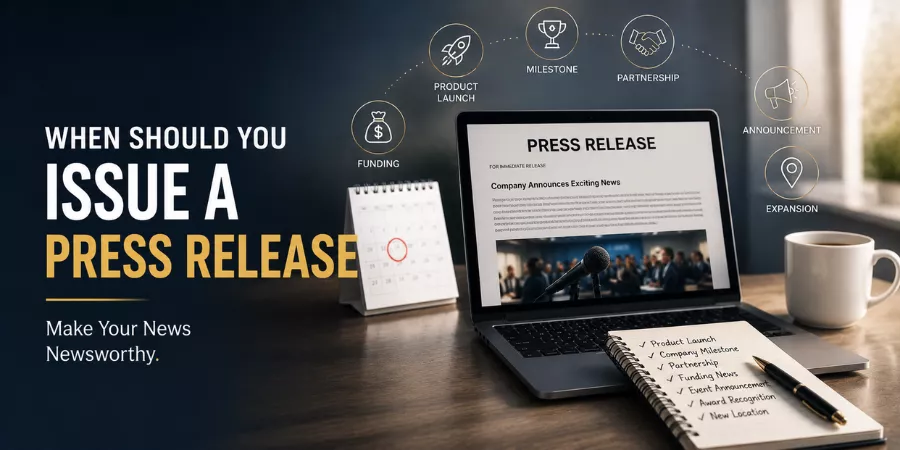
The best time to send a press release is Tuesday through Thursday, between 10 a.m. and 2 p.m. in your target journalist’s local time.
- For planned launches and announcements, two to three weeks ahead is the standard lead time.
- For events, send an initial release two weeks out and a reminder two to three days before.
- For magazines, work 3 to 6 months ahead.
- For breaking news, send the moment it is verified.
Timing helps, but news value determines whether any of it matters. Let us understand them in great detail:
If you are still building the release itself, this step-by-step guide on how to write a press release covers structure, language, and examples.
What is the Best Time to Send a Press Release?
Tuesday through Thursday, late morning.
- ACCESS Newswire recommends 10 a.m. to 2 p.m.
- Respona mentions studies ranging from 7 to 9 a.m. through early afternoon.
- And Prowly’s 2024 analysis found Tuesday generated the highest open rates, with Wednesday close behind.
The reason they all point toward the same general window, despite disagreeing on the exact hour is because you want to land in a journalist’s inbox when they are actively working, not clearing overnight email, not wrapping up the day, not preparing for an editorial meeting they are already late for.
Best Days to Send a Press Release
| Day | Effectiveness | Why |
| Tuesday | Strong | Mid-week, inbox cleared from Monday |
| Wednesday | Strong | Active news cycle, editorial decisions being made |
| Thursday | Good | Still productive, story can run Friday or weekend |
| Monday | Weak | Congested from weekend backlog |
| Friday | Poor for planned news | Newsrooms winding down |
| Weekend | Avoid unless breaking | Minimal newsroom staffing |
B2B technology releases targeting enterprise editors behave differently from consumer lifestyle announcements. But Tuesday to Thursday is where you start unless you have a specific reason to deviate.
How Far in Advance Should You Send a Press Release?
| Announcement Type | Lead Time |
| Breaking news | Immediately |
| Product launch | 2–3 weeks before launch |
| Business or industry event | About 2 weeks before |
| Event reminder | 2–3 days before |
| Post-event announcement | As soon as possible after |
| Trending news response | Immediately |
| Magazine coverage | 3–6 months ahead |
| Embargoed announcement | Per agreed embargo terms |
| Funding or acquisition | At point of public announcement |
The 2-to-3-week recommendation for product launches exists because journalists need time to pitch the story internally, schedule interviews, and file before your launch date. Send too early and the story feels stale before it runs. Send too late and you miss the editorial window entirely.
Trade publications and consumer media operate on completely different schedules. A technology trade outlet covering enterprise software may need your story 3 weeks out to fit their editorial cycle. A consumer tech blog may prefer it one week before launch so the review feels fresh. Know your target publications before locking in the timeline.
When Should Breaking News Go Out Immediately?
Some announcements cannot wait for Tuesday. News relevance has an expiry date, missing it is worse than imperfect timing.
Send immediately for:
- Crisis communications where silence creates its own narrative
- Regulatory announcements with legally mandated disclosure timing
- Major acquisitions or mergers timed to simultaneous public announcement
- Significant funding rounds tied to a specific market window
- Executive departures or appointments at the moment of confirmation
- Responses to a fast-moving news cycle where your story is directly relevant
- Original research tied to a current event
A genuinely significant story sent on a Saturday afternoon will still get coverage. Holding it until Tuesday to honour a timing rule costs you the story entirely. The press release timing guidelines exist for planned news. Breaking news makes its own rules.
When Should You Send a Press Release Before an Event?
Event PR works best as a 3-stage process. Most organisations use one or two stages. All three together produce measurably more coverage.
- Two weeks before: The initial announcement. You are telling journalists the event is happening, what it covers, who is involved, and why readers should care. Two weeks gives editors enough time to assign a reporter and plan coverage without the story feeling premature.
- Two to three days before: A reminder, but only if it contains something new. An additional speaker, an exclusive data point, an unexpected angle. Journalists notice when the second release is a copy-paste of the first, and it trains them to ignore your follow-ups. Give them a reason to open it.
- After the event: Results, quotes, images, video, notable outcomes. Post-event press releases are significantly underused. A well-packaged post-event release with strong supporting material can generate coverage that the advance announcement never achieved, because journalists can file it quickly with everything they need already provided.
When Should You Send a Press Release to Magazines?
Magazine press release timing operates in a different world from daily news and requires a separate strategy.
Glossy print magazines typically work 3 to 6 months ahead of publication.
A product announcement intended for a December issue needs to reach the relevant editor by late summer at the latest, earlier if the publication runs special themed issues, annual rankings, or award features.
The most reliable approach is to request the publication’s editorial calendar directly. Most magazines publish these for advertisers and PR professionals. If your announcement aligns with a planned feature, that alignment alone gives you a significant advantage over releases arriving without context.
Monthly and quarterly trade publications follow the same logic with slightly varying timelines. The rule of thumb, 3 to 6 months, is a starting point, not a fixed answer.
How Do You Know Whether Your Press Release is Actually Worth Sending?
To know whether your press release is worth sending, adhere to the below list of questions:
- Does the announcement have real news value? Remove your company name from the headline. Would the story still interest anyone outside your organisation? If not, it is probably an internal announcement in press release clothing.
- Would someone outside the company care? Journalists write for their readers, not for your marketing team. New client wins, minor product updates, and internal promotions rarely meet the bar unless your company operates at a scale where those things are independently significant.
- Is there data or verifiable evidence? Releases built on specific figures, original research, or independently verifiable claims give journalists something to work with. Releases built on adjectives give them nothing.
- Does the story fit a journalist’s beat? Sending a cybersecurity announcement to a journalist who covers retail trends is not media outreach, it is noise. Targeted journalist pitch efforts consistently outperform broad press release distribution lists because relevance determines whether an email gets opened at all.
- Is the story original? If 3 competitors already announced the same development last week, your version is not news. It is a follow-up at best.
What Can Kill Coverage Even When the Timing is Right?
Timing is one variable. These are the others that determine whether a release generates coverage or disappears:
- Weak news value: the most common reason releases fail
- Promotional language: journalists edit it out or stop reading
- No supporting images or data: leaves journalists with nothing usable
- Generic distribution: broad lists without targeting produce low response rates
- Sending into a dominant news day: releasing against major breaking news reduces visibility significantly.
- Aggressive follow-up: repeated contact before journalists have had time to respond damages the relationship before it starts.
On follow-up specifically: one personalised message, sent around five days after distribution, to a journalist who genuinely covers your area is reasonable. More than that is counterproductive.
Press Release Timing: Quick Reference
| Question | Answer |
| Best day to send? | Tuesday or Wednesday |
| Best time to post a press release? | 10 a.m. to 2 p.m., recipient’s time zone |
| Lead time for a product launch? | 2–3 weeks before launch |
| Lead time for an event? | 2 weeks initial, 2–3 days reminder |
| When does breaking news go out? | Immediately, once verified |
| Magazine lead time? | 3–6 months, per editorial calendar |
| Friday for planned news? | Avoid |
| Time zones matter? | Yes, schedule for the recipient’s working hours |
| Does timing guarantee coverage? | No, news value and targeting matter more |
FAQs
What is the best time to send a press release?
Tuesday or Wednesday, between 10 a.m. and 2 p.m. in the recipient’s local time zone. Some research favours 7 to 9 a.m. to arrive before morning editorial meetings. The right answer depends on your target publication’s working rhythm.
How far in advance should I send a press release for a product launch?
Two to three weeks before the launch date is the standard recommendation. Check your most important target publications first, trade media often need longer lead times than consumer outlets.
What makes a press release newsworthy?
Original research, significant business developments, major funding, notable partnerships, substantial executive changes, or a direct response to a current industry story. The test is whether a journalist covering your sector would pitch this to their editor unprompted.
Should I send a press release before or after an event?
Both, and during. An initial announcement two weeks out, a reminder with a new angle two to three days before, and a post-event release with results and quotes as soon as possible after. Most organisations send only one of these three.
What is the difference between a press release and a journalist pitch?
A press release is a structured announcement. A journalist pitch is a personalised, often short message to a specific reporter explaining why a story fits their beat and readership. The two work together, the pitch secures attention, the release provides supporting detail. For companies without established brand recognition, the pitch frequently matters more than the release itself.
How often should a company send press releases?
Often enough to stay visible, infrequently enough that each release carries genuine news value. Organisations that distribute constantly train journalists to ignore them. One strong release every four to six weeks outperforms weekly minor updates every time.
Does press release timing vary by industry?
Yes. Financial services, healthcare, and regulated industries often have legally mandated timing for certain announcements. B2B technology releases targeting trade media follow different editorial cycles from consumer lifestyle announcements. Know your industry’s conventions before applying general timing advice.